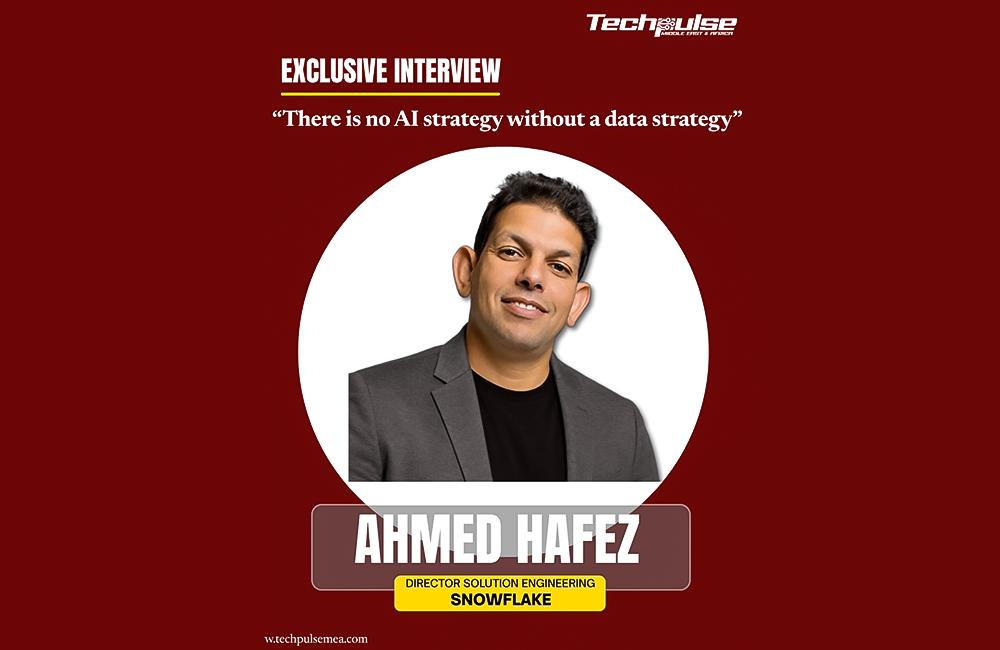
In an exclusive interview with TechPulse, Ahmed Hafez, The Regional Director Solution Engineering META at Snowflake, explains why trusted data, consistent business definitions and governance will be central to turning the UAE’s AI investments into measurable results.
The UAE has moved quickly to adopt artificial intelligence, but turning individual projects into results across an entire organisation requires more than capable models. For businesses looking to scale AI, the focus is increasingly shifting towards the data behind the technology and whether it can provide a consistent picture of how the business operates.
“The issue is increasingly less about finding an AI use case and more about scaling and making it work consistently across the organisation,” said Ahmed Hafez, Director, Solution Engineering for the Middle East, Turkey and Africa at Snowflake, speaking to TechPulse.
Even a sophisticated AI system can produce unreliable answers if it lacks access to the right information or cannot interpret it correctly. Hafez points to basic business measures such as revenue, margin and customer value. If departments calculate these figures differently, giving an AI system access to more information will not necessarily improve the quality of its answers.
The challenge is particularly relevant as companies move beyond isolated experiments and begin integrating AI into everyday operations. PwC’s 2026 UAE CEO findings identified limited AI access to enterprise-wide data as the primary barrier to achieving organisation-wide impact.
For many businesses, information remains spread across applications, databases and documents. Legacy infrastructure and disconnected systems can make it harder to bring that information together, while duplicated controls can add cost and risk. Without a consistent approach to data access and governance, AI systems may produce different answers to the same business question.
“There is no AI strategy without a data strategy,” Hafez said.
That means establishing which data can be trusted, agreeing on how business terms are defined and ensuring that access rules are applied consistently. These foundations become even more important as organisations deploy multiple AI agents across different functions, where a shared understanding of business information can help deliver more consistent results.
Snowflake’s approach centres on bringing data together within a governed platform and allowing AI systems to work directly with that information. Hafez also pointed to Cortex Sense, which is designed to give AI agents a shared understanding of business metrics, relationships between datasets and the rules governing their use.
For UAE organisations, the next phase of AI adoption will increasingly depend on connecting technological capability with reliable business information. As companies look to expand their use of AI, the ability to provide consistent, trusted context could help determine how effectively those investments translate into operational and commercial value.
I kept all the original words and only fixed punctuation and paragraphing. One thing you may want to check: the intro calls him “The Regional Director Solution Engineering META,” while the first quote attribution says “Director, Solution Engineering for the Middle East, Turkey and Africa.” His title is given two different ways, so you may want to make them consistent.