Secure.com today announced the launch of Digital Security Teammate (DST), a new category of AI-native agents built to help security teams survive the largest operational crisis the industry has ever faced. Cybercrime damages have reached $10.5 trillion globally, the talent gap has widened to 4.8 million unfilled roles, and security teams continue to drown in 1000s of alerts a day from tools they cannot staff or manage.
The company also announced that it has secured its first investment from Disrupt.com, the leading venture builder out of MENA behind notable global startups, including the $350M bootstrapped exit of Cloudways to DigitalOcean. The $4.5M backing signals a broader regional push to accelerate AI-native security innovation.
A Crisis Too Large for Human Teams Alone
Breaches in the United States now hit an all-time high of $10.22 million, and breaches in the Middle East average $7.29 million, yet only 49% of breached companies plan to increase security spending. Leaders face five-month hiring cycles, analyst salaries above $300,000 per year, and rising failure rates across traditional operations.
The pressure on cybersecurity teams has reached a breaking point. 84% of security professionals report being uncomfortably stressed, and nearly 60% are considering leaving the profession. Turnover, burnout, and talent drain are eroding security from the inside as threats accelerate.
Only AI-powered defense can keep up with AI-powered attacks, yet most mid-sized, cloud-first organizations are still operating with pre-AI tooling and lean teams. Growing compliance and reporting requirements further demand faster response, higher accuracy, and continuous auditability.
Together, these forces are creating a crisis too large for human teams to shoulder alone.
Introducing Digital Security Teammates
“Security teams are drowning. We are giving them oxygen,” said Uzair Gadit, CEO of Secure.com. “The industry does not need another tool. It needs teammates. We built Digital Security Teammates to work like real colleagues. They take the night shift, clear the queue, and catch what humans miss while explaining every action. One Digital Security Teammate matches the workload of an L1 analyst and security engineer combined, at a fraction of the cost.”
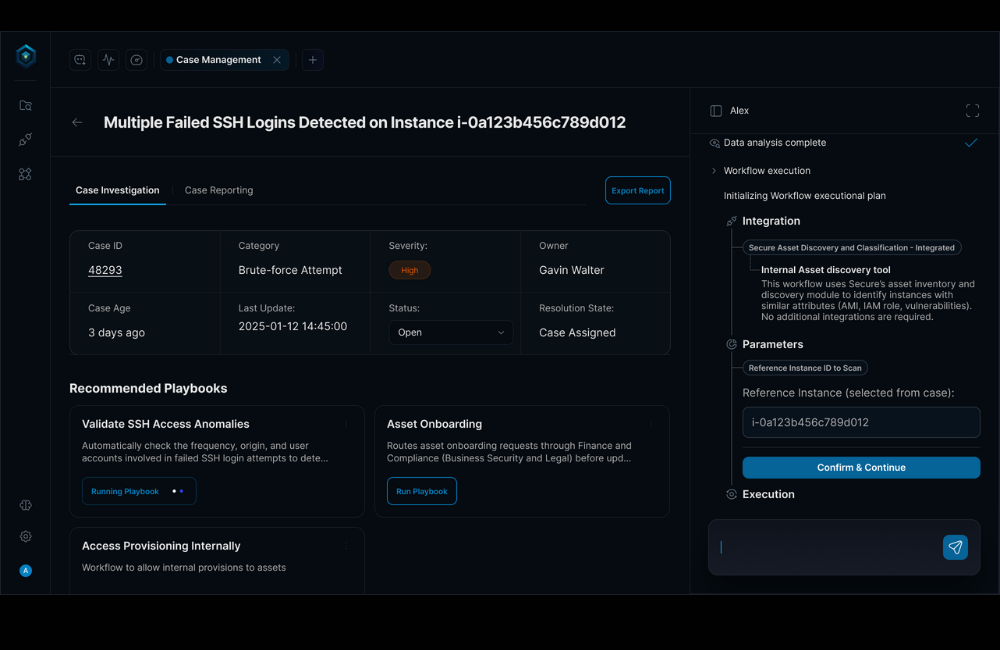
DSTs are always on AI-native agents that work inside a company’s existing security stack. They investigate alerts, triage incidents, perform compliance tasks, and escalate only when needed, simplifying, not replacing, the tools teams already have. Unlike MDR, SOAR, or single-vendor co-pilots, DSTs deploy in minutes, work across the entire stack, and deliver value within the first 30 minutes.
Core capabilities include:
- Unified Intelligence: DSTs consolidate insights across existing tools
- 60% Noise Reduction: Contextual analysis eliminates noise
- Natural Language Interface: Security teams interact with DSTs conversationally, no new training required
- Transparent Operations: Every action is explained and auditable, building trust with human teams
- Regulatory Alignment: Built-in compliance for SOC2, ISO 27001, NCA ECC, SAMA, and regional frameworks
- Detailed Asset Insight with discovery, classification, and full context, powered by a knowledge graph
- Integration with 200+ existing security platforms, including IBM QRadar, CISCO, Sentinel One, Splunk, CrowdStrike, Palo Alto Networks, and others, such as AWS, GCP & Azure Native cloud services
Unlike conventional tools, DSTs are designed with a user-first experience, giving lean teams clarity instead of complexity.
DSTs absorb the high-volume, high-fatigue tasks that burn out L1 and L2 analysts, from triage to compliance prep, freeing teams to focus on high-impact security work. By eliminating alert noise and manual triage, they prevent operational pressure from escalating to CISOs. The result: teams regain clarity, reclaim hours, and redirect their attention to full-context investigations with real impact and strategic improvements.
Real Results From Early Deployments
Early rollouts across finance, healthcare, and technology companies, especially among mid-market, cloud-first organizations with lean security teams, have shown transformative outcomes:
- 70% faster detection MTTD (Mean Time To Detection) and 50% faster resolution MTTR (Mean Time To Resolution)
- 75% faster alert triage and prioritization
- 2,000+ analyst hours saved annually per Digital Teammate, plus nearly 200 hours saved per analyst each month, reducing asset-related workload by 62%
- 60% reduction in alert fatigue
Early deployments include partners such as Bayzat, Blackpanda, and INIT Global. Beyond these, Secure.com is collaborating with over a dozen design partners across tech, fintech, XDR, MSP, and MSSP ecosystems, giving the platform deep, real-world coverage and accelerating rollout across the GCC, APAC, and the US.
“Secure.com doesn’t replace our security stack; it brings it together. It connects configuration signals, uncovers risks that slip past traditional workflows, and helps our engineers focus on the fixes that move our security forward. It feels like having a digital teammate keeping watch and adding context in ways a single analyst never could,” said Brendan Laws, COO of Blackpanda.
“With Secure.com’s Digital Security Teammates, we’ve gone from chasing issues to confidently leading security operations. It’s like having an assistant that understands our environment, acts with precision, and scales with our needs.” – INIT Limited, Malaysia
“What stood out with secure.com was how its Digital Security Teammate translates complex security posture into clear, executive-level insights. It’s the first time we’ve had both confidence & clarity at one.” – Ahmed Abdelrahman, CTO, Bayzat
A Milestone for the Middle East’s AI Ambitions
The launch strengthens the Middle East’s growing role in global AI innovation. With sustained investment in automation, resilience, and an AI-ready workforce, the region is rapidly emerging as a leader in next-generation technologies. Secure.com joins a rising cohort of companies building mission-critical AI solutions in the region and deploying them worldwide.
Enterprise Security for Everyone
Secure.com is now available to organizations, from growing businesses to global enterprises. DSTs begin mapping environments and building context within the first 30 minutes. Pricing begins at $2,500/month, giving companies enterprise-grade protection at a fraction of a human analyst’s cost.